
Bitcoin halving is one of the most important events in cryptocurrency, yet most people only hear about it when prices start moving. If you’re trying to understand what drives Bitcoin’s long-term value, halving is a big piece of the puzzle.
In simple terms, Bitcoin halving reduces how quickly new coins are created, which directly impacts supply. That change has historically influenced price cycles, investor behaviour, and market expectations.
This guide breaks down how Bitcoin halving works, why it exists, when the next halving is expected, and what it means if you’re buying or holding Bitcoin in Canada.
Key Takeaways
- Bitcoin halving happens about every four years and cuts mining rewards in half.
- It slows the creation of new Bitcoin, reducing supply growth.
- Past halvings have been followed by major price increases, though not immediately.
- The next Bitcoin halving is expected in 2028.
- Long-term strategies like dollar-cost averaging are commonly used around halving cycles.
- Bitcoin ATMs provide a simple way to participate without using online exchanges.
Table of Contents
- What Is Bitcoin Halving
- What Gets Halved in Bitcoin Halving
- What Is Bitcoin Mining
- How Bitcoin Halving Works
- Bitcoin Halving Schedule and History
- When Is the Next Bitcoin Halving
- Why Bitcoin Halving Exists
- Impact of Bitcoin Halving on Price
- What Bitcoin Halving Means for Investors
- Using Bitcoin ATMs as a Strategy
- How to Buy Bitcoin at a HODL ATM
- FAQs About Bitcoin Halving
What Is Bitcoin Halving?
Bitcoin halving is a pre-programmed event that’s built into Bitcoin’s code and happens automatically about every four years. Historically, halving has caused Bitcoin values to rise dramatically. If you’re interested in Bitcoin halving and how to use it in your cryptocurrency investment strategy, this guide covers the key concepts, timing of halvings, historic effects of halving on prices, and how to use HODL ATMs for your Bitcoin investment strategy.
| Simple Definition: Bitcoin halving is a scheduled event that reduces the reward miners receive for adding new blocks to the blockchain by 50 percent, slowing the rate at which new Bitcoin is created. |
What Gets “Halved” in Bitcoin Halving?
In Bitcoin halving, the Bitcoin themselves are not split in half; instead, it’s the rewards for mining Bitcoin that are halved. To learn how this works, you first need to understand mining and mining rewards.
What Is Bitcoin Mining?
Bitcoin mining happens when miners (usually companies with large-scale computing capacity) perform computational work to validate Bitcoin transactions so they can be added to the blockchain. Essentially, they work as auditors, ensuring the integrity of the blockchain. When a miner successfully validates a block of transactions, they receive a reward in newly created Bitcoin.
Rewards compensate miners for the electricity and computational power they use, but they play another important role: they introduce new Bitcoin into circulation. The problem is that these rewards can’t be issued indefinitely: circulation is permanently capped at 21 million coins, and coins are never taken out of circulation. The halving process slows down the number of new coins being issued so that the cap isn’t reached until 2140.
Glossary of Key Bitcoin Halving Terms
| Bitcoin Halving | A pre-programmed event that reduces the mining reward by half approximately every four years, slowing the rate at which new Bitcoin enters circulation. |
| Block | A group of verified Bitcoin transactions that are added to the blockchain. Each block is created roughly every 10 minutes. |
| Block Reward | The amount of Bitcoin a miner receives for successfully validating a block of transactions. This reward is reduced during halving events. |
| Mining (Bitcoin Mining) | The process of using computing power to validate transactions and add new blocks to the blockchain. Miners are rewarded with Bitcoin for this work. A miner is an individual or organization that participates in Bitcoin mining by validating transactions and securing the network. |
| Supply | The total amount of Bitcoin available in circulation. Bitcoin’s supply is limited to 21 million coins and grows at a decreasing rate due to halving. |
| Demand | The level of interest from buyers who want to purchase or hold Bitcoin. Demand plays a major role in determining price. |
| Inflation (Crypto Context) | An increase in the supply of Bitcoin. Higher supply can reduce the purchasing power of each coin if demand does not keep up. |
| Scarcity | The limited availability of Bitcoin. Because supply is capped and issuance slows over time, Bitcoin becomes increasingly scarce. |
| Satoshi | The smallest unit of Bitcoin, equal to 0.00000001 BTC. Named after Bitcoin creator Satoshi Nakamoto. |
| Block Height | The number of blocks that have been added to the blockchain. Halving events occur at specific block heights (every 210,000 blocks). |
| Dollar-Cost Averaging (DCA) | An investment strategy where you buy a fixed amount of Bitcoin at regular intervals, regardless of price, to reduce the impact of volatility. |
How Does Bitcoin Halving Work
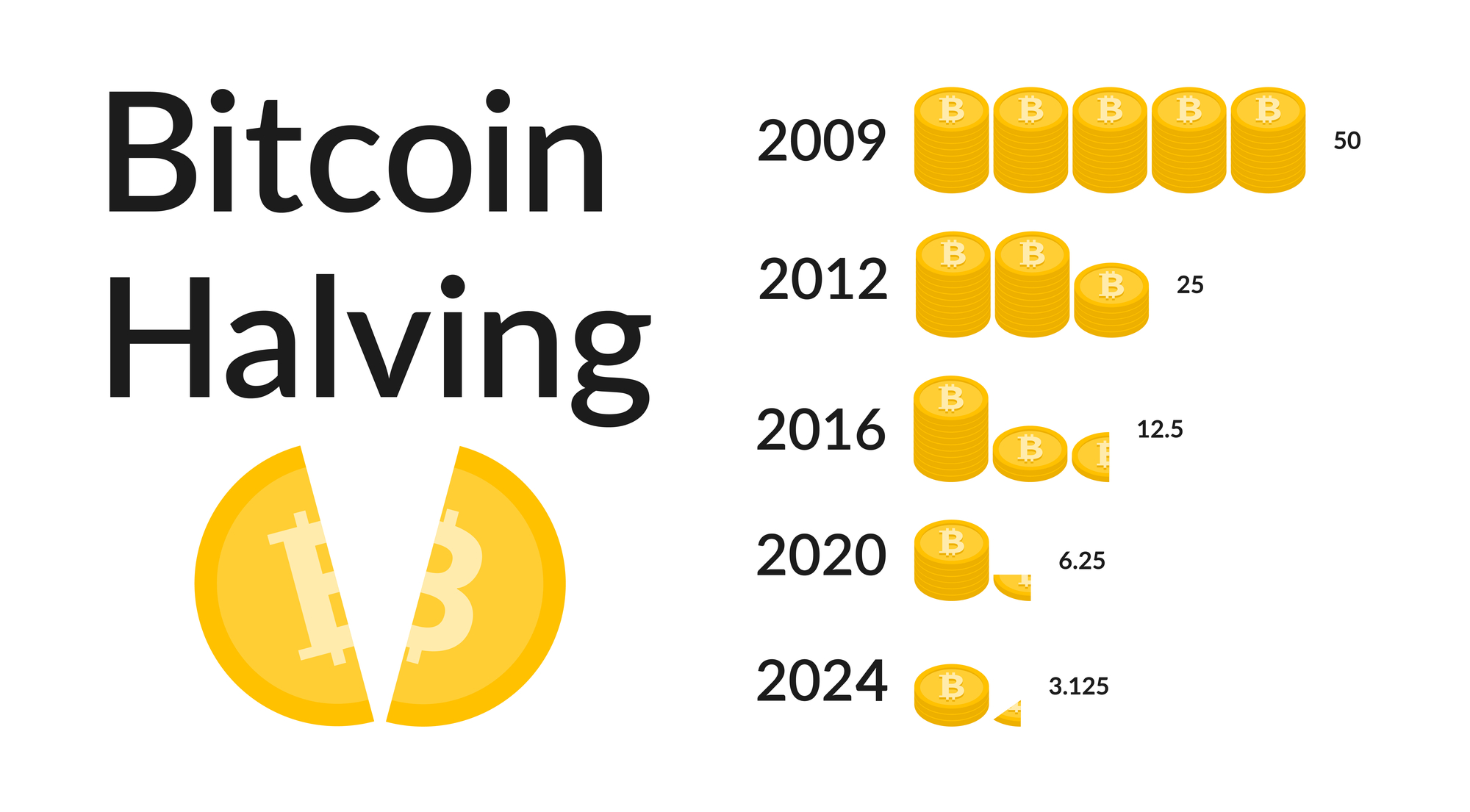
The halving process was built into Bitcoin’s original code. When Bitcoin launched in 2009, miners were rewarded with 50 Bitcoin for each block they mined. Bitcoin’s protocol automatically cuts this reward in half with every 210,000 blocks that are mined. Although the exact dates can’t be predicted, halving happens about every four years.
Bitcoin Halving Schedule and History
Bitcoin halving happens every 210,000 blocks, which works out to roughly every four years. Each event reduces the mining reward by half, slowing the rate at which new Bitcoin enters circulation.
The table below shows every Bitcoin halving event, including the block height and how rewards have changed over time.
| Halving Date | Block Height | Reward Before | Reward After |
|---|---|---|---|
| November 28, 2012 | 210,000 | 50 BTC | 25 BTC |
| July 9, 2016 | 420,000 | 25 BTC | 12.5 BTC |
| May 11, 2020 | 630,000 | 12.5 BTC | 6.25 BTC |
| April 19, 2024 | 840,000 | 6.25 BTC | 3.125 BTC |
Each Bitcoin halving cuts new supply in half, reducing inflation and increasing scarcity over time. This predictable reduction in supply is one of the main reasons Bitcoin is often compared to scarce assets like gold.
When Is the Next Bitcoin Halving?
The next Bitcoin halving time is expected in March or April of 2028, when the network reaches block 1,050,000. At that time, the mining reward will decrease to 1.5625 BTC per block. Multiple websites track Bitcoin halving time by continually updating the addition of new blocks as they are mined. Predictions about the date become more accurate as the next block height threshold approaches.
Halving of Bitcoin will continue until the coins can no longer be divided into parts (the smallest unit of division is 1 Satoshi, or 0.00000001 BTC). At that point, miners will be rewarded via transaction fees rather than in BTC.
The Purpose of Bitcoin Halving
Halving Bitcoin was part of the original plan for this cryptocurrency, rather than a modification added later. So, what was Bitcoin creator Satoshi Nakamoto thinking when he included halving in the coin’s source code? He was trying to solve these key problems:
Securing the Blockchain When It Had Few Users
In Bitcoin’s early days, the network was small, with very few users, no established infrastructure, and a coin that had almost no value. To make sure the system could grow securely over time, large mining rewards were offered. This helped maintain the blockchain’s integrity and ensure that it had enough computing power in its early, most vulnerable stages of development.
However, Satoshi Nakamoto also set an upper limit for the number of Bitcoin that could ever be issued. Bitcoin halving ensured that the limit wasn’t reached too quickly, which would have flooded the market with BTC.
Controlling Inflation
In crypto terms, inflation happens when supply exceeds demand. Bitcoin halving keeps the supply under control, so that the coin retains its value. By lowering the mining rewards on a predictable schedule and setting an upper limit on the number of coins in circulation, the supply part of the equation is controlled.
Creating Scarcity
Scarcity raises value. With commodities like precious metals, value is based on how rare the metal is or how difficult it is to extract and refine it. With cryptocurrencies, value is based on the balance between supply and demand. Slowing down the issuance of new coins has kept Bitcoin supply under control and helped maintain the coin’s value.
Increasing Predictability
Traditional fiat currencies like the Canadian dollar can be printed in unlimited quantities by central banks. This increases supply and, over time, reduces purchasing power through inflation, over which ordinary citizens have little control. With Bitcoin halving, the rate and timing of supply growth is highly predictable, and everyone has insight into when it will happen.

Impact of Bitcoin Halving on Price
Knowing what happened after previous halvings can be helpful in planning your investment strategy and figuring out what to watch for.
2012 Halving
Prior to the 2012 halving, Bitcoin was trading at about $12. One year later, prices were around $1000, an 8000% increase. This indicated that halving had a positive effect on prices, but interest in cryptocurrencies had also increased, which could have led to the value increase on its own.
2016 Halving
Before the second halving event, Bitcoin was trading at around $650. By December 2017, about 18 months later, prices reached $20,000. Cryptocurrency was mainstream by that time, and Bitcoin was regarded as the gold standard.
2020 Halving
At the 2020 halving, Bitcoin was trading at around $8,800. Six months later, prices had reached $14,800, and one year after that, prices reached an all-time high of $69,000. A clear pattern was surfacing.
2024 Halving
The 2024 Bitcoin halving broke the pattern followed by previous halvings. Bitcoin had hit an all-time high of $73,000 just before the April halving. Prices rose only slightly after the event. This interruption in the pattern could be due to a few different factors, including anticipation of a price increase and the approval of Bitcoin exchange-traded funds (ETFs).
Overall, Bitcoin prices have risen steadily since 2009, with noticeable increases after halving events, although the increases were not immediate. The pattern change in the 2024 halving may indicate that buyers are becoming more savvy about crypto investing and are working anticipated price increases into the pricing in advance.
Is Bitcoin Halving Bullish or Bearish?
Bitcoin halving is generally considered bullish over the long term because it reduces the rate of new supply entering the market. However, price increases are not guaranteed and often depend on demand, market sentiment, and macroeconomic conditions.
Historically, Bitcoin has experienced strong price growth in the months and years following halvings, but short-term volatility is common. Many investors view halving as part of a longer market cycle rather than a single price-moving event.
What Bitcoin Halving Means for Investors
If you’re keeping an eye on halving dates and their effect on pricing, you may want to know what halvings mean for your Bitcoin investment.
Decreasing Supply Growth
Each halving increases the amount of Bitcoin in circulation, but by incrementally smaller amounts. If demand remains stable or increases, and there are no other major changes in the market, the price of Bitcoin is likely to rise. Buying and holding Bitcoin prior to halving can be a smart strategy with a few caveats.
Increasing Importance of Demand
Although growth in Bitcoin supply is predictable, demand is less so, and it ultimately depends on:
- Adoption by users and institutions.
- Economic conditions.
- Regulatory developments.
- Investor/market sentiments.
As supply increases slowly, pricing will increasingly depend on demand. Investors with the most accurate insights, analytical tools and skills will be in the best position as investors.
Greater Influence of Market Expectations
Historically, price appreciation has occurred in the months leading up to a halving of Bitcoin, in the period following it, and sometimes well into the cycle. Markets are becoming more sophisticated when it comes to pricing in anticipated value increases, which makes it more difficult to time purchases.
Taking a Longer-Term Perspective
The increasing scarcity of Bitcoin, combined with the relative unpredictability of demand and the changes in price increase patterns, means that investors need to take a longer-term perspective. Aiming for short-term gains can be a successful strategy, but relying on it exclusively may not be a sound plan. Many investors view their Bitcoin acquisition strategy through a multiyear lens rather than focusing on a single Bitcoin halving event.
Dollar-cost averaging is a popular approach to evening out the effects of price fluctuations. Dollar-cost averaging involves evenly timed investments of the same amount over an extended period, which smooths out the effects of volatility and reduces reliance on specific events.
Using HODL ATMs for Your Bitcoin Investment Strategy
Many investors believe that online exchanges are their only option for investing in Bitcoin. However, there are many advantages to using a HODL ATM for purchases and sales.
Immediate Access to Bitcoin
Crypto ATMs allow you to purchase Bitcoin on the spot using cash or debit, without waiting for bank transfers or exchange approvals. You don’t have to worry about account opening delays or waiting for funding to go through. This can be especially useful when you want to react quickly to pricing changes.
Simplicity and Ease of Use
For new users, exchanges can feel overwhelming. They often feature numerous charts and graphs with analytics that may be more confusing than useful. At a crypto ATM, the process is as simple as scanning your wallet QR code, inserting cash, selecting your transaction, and confirming it.
Facilitates Dollar Cost Averaging
HODL’s cryptocurrency ATM’s make it easier to build a habit of regular purchases, consistent with dollar-cost averaging. If using a nearby ATM becomes part of your routine, building a solid investment habit becomes natural. Crypto ATMs are especially useful for these smaller incremental purchases.
Physical Access
Some investors feel more comfortable making crypto purchases at a HODL machine because it’s similar to using an ATM at a bank. It’s a physical machine that you can see and examine, and most of them are located in places that are already familiar. HODL Digital Services’ network of over 300 Bitcoin ATMs across Canada makes access easy. Use our location finder for the machine closest to you.
Cash-Based Transaction
If you’re unbanked or underbanked, you may not have access to credit cards or other ways of making online transactions. Cash transactions can also be more suitable for people who earn money primarily in cash or who prefer not to link their crypto transactions to their bank accounts.
How to Buy Bitcoin at a HODL ATM
Before You Go
- Set up a crypto wallet.
- Decide how much you want to spend.
- Bring valid government-issued ID and phone.
At the ATM
- Find a HODL ATM.
- Choose “Buy Bitcoin”.
- Complete verification (if required).
- Scan your wallet QR code.
- Insert cash.
- Review and confirm.
- Take your receipt.
After the Transaction
- Check your wallet for pending transaction.
- Check for full confirmation in 30-60 min.
Bitcoin halving plays a central role in how Bitcoin maintains scarcity and controls supply over time. While it has historically been linked to price growth, it does not guarantee short-term gains.
For investors, understanding halving cycles is less about timing the market and more about building a consistent, long-term strategy.
With HODL Digital Services’ network of Bitcoin ATMs across Canada, you can buy Bitcoin quickly and securely, making it easier to stay consistent no matter where you are in the cycle.
FAQs About Bitcoin Halving
1. What is Bitcoin halving?
Bitcoin halving is an event that happens about every four years, where the reward miners receive for validating transactions is cut in half. This reduces the number of new bitcoins entering circulation.
2. When is the next Bitcoin halving?
The next Bitcoin halving is expected to occur around March or April of 2028, when the network reaches block number 1,050,000. At that point, mining rewards will drop from 3.125 BTC to 1.5625 BTC per block.
3. Does Bitcoin halving increase the price?
Halving can result in higher prices by reducing new supply, but it doesn’t guarantee price increases. Bitcoin’s value still depends on demand, market conditions, and investor sentiment.
4. Why does Bitcoin halving happen?
Bitcoin halving was built into the source code for Bitcoin. The intention of halving is to control supply, reduce inflation over time, and ensure that new coins are introduced gradually instead of all at once.
5. How often does Bitcoin halving occur?
Bitcoin halving occurs every 210,000 blocks, which happens approximately every four years.
6. Is Bitcoin halving good for investors?
Halving can create favourable conditions for long-term investors by slowing supply growth. However, it’s not guaranteed to make a profit, and prices can still fluctuate significantly.
7. What’s the best strategy around Bitcoin halving?
Many investors focus on long-term strategies such as buying consistently over time (dollar-cost averaging) rather than trying to time purchases to line up with halving dates.